**** If you received this email, please reply to me with the words "I got it" ****
Our English 1010 class home page is:
http://tenmoreminutes.blogspot.com
today in class we submitted drafts, wrote a reflective memo, and signed up for http://prenhall.com/harris and took a grammar quiz.
For next class period: Read the article I have linked to and included below. Please read it closely, and be prepared to answer this question, and many others:
How does Gladwell try to persuade us?
What are some examples of good description in this essay?
http://www.newyorker.com/fact/content/articles/050829fa_fact
THE MORAL-HAZARD MYTH
by MALCOLM GLADWELL
The bad idea behind our failed health-care system.
Issue of 2005-08-29
Posted 2005-08-22
Tooth decay begins, typically, when debris becomes trapped between the teeth and along the ridges and in the grooves of the molars. The food rots. It becomes colonized with bacteria. The bacteria feeds off sugars in the mouth and forms an acid that begins to eat away at the enamel of the teeth. Slowly, the bacteria works its way through to the dentin, the inner structure, and from there the cavity begins to blossom three-dimensionally, spreading inward and sideways. When the decay reaches the pulp tissue, the blood vessels, and the nerves that serve the tooth, the pain starts—an insistent throbbing. The tooth turns brown. It begins to lose its hard structure, to the point where a dentist can reach into a cavity with a hand instrument and scoop out the decay. At the base of the tooth, the bacteria mineralizes into tartar, which begins to irritate the gums. They become puffy and bright red and start to recede, leaving more and more of the tooth's root exposed. When the infection works its way down to the bone, the structure holding the tooth in begins to collapse altogether.
Several years ago, two Harvard researchers, Susan Starr Sered and Rushika Fernandopulle, set out to interview people without health-care coverage for a book they were writing, "Uninsured in America." They talked to as many kinds of people as they could find, collecting stories of untreated depression and struggling single mothers and chronically injured laborers—and the most common complaint they heard was about teeth. Gina, a hairdresser in Idaho, whose husband worked as a freight manager at a chain store, had "a peculiar mannerism of keeping her mouth closed even when speaking." It turned out that she hadn't been able to afford dental care for three years, and one of her front teeth was rotting. Daniel, a construction worker, pulled out his bad teeth with pliers. Then, there was Loretta, who worked nights at a university research center in Mississippi, and was missing most of her teeth. "They'll break off after a while, and then you just grab a hold of them, and they work their way out," she explained to Sered and Fernandopulle. "It hurts so bad, because the tooth aches. Then it's a relief just to get it out of there. The hole closes up itself anyway. So it's so much better."
People without health insurance have bad teeth because, if you're paying for everything out of your own pocket, going to the dentist for a checkup seems like a luxury. It isn't, of course. The loss of teeth makes eating fresh fruits and vegetables difficult, and a diet heavy in soft, processed foods exacerbates more serious health problems, like diabetes. The pain of tooth decay leads many people to use alcohol as a salve. And those struggling to get ahead in the job market quickly find that the unsightliness of bad teeth, and the self-consciousness that results, can become a major barrier. If your teeth are bad, you're not going to get a job as a receptionist, say, or a cashier. You're going to be put in the back somewhere, far from the public eye. What Loretta, Gina, and Daniel understand, the two authors tell us, is that bad teeth have come to be seen as a marker of "poor parenting, low educational achievement and slow or faulty intellectual development." They are an outward marker of caste. "Almost every time we asked interviewees what their first priority would be if the president established universal health coverage tomorrow," Sered and Fernandopulle write, "the immediate answer was 'my teeth.' "
The U. S. health-care system, according to "Uninsured in America," has created a group of people who increasingly look different from others and suffer in ways that others do not. The leading cause of personal bankruptcy in the United States is unpaid medical bills. Half of the uninsured owe money to hospitals, and a third are being pursued by collection agencies. Children without health insurance are less likely to receive medical attention for serious injuries, for recurrent ear infections, or for asthma. Lung-cancer patients without insurance are less likely to receive surgery, chemotherapy, or radiation treatment. Heart-attack victims without health insurance are less likely to receive angioplasty. People with pneumonia who don't have health insurance are less likely to receive X rays or consultations. The death rate in any given year for someone without health insurance is twenty-five per cent higher than for someone with insur-ance. Because the uninsured are sicker than the rest of us, they can't get better jobs, and because they can't get better jobs they can't afford health insurance, and because they can't afford health insurance they get even sicker. John, the manager of a bar in Idaho, tells Sered and Fernandopulle that as a result of various workplace injuries over the years he takes eight ibuprofen, waits two hours, then takes eight more—and tries to cadge as much prescription pain medication as he can from friends. "There are times when I should've gone to the doctor, but I couldn't afford to go because I don't have insurance," he says. "Like when my back messed up, I should've gone. If I had insurance, I would've went, because I know I could get treatment, but when you can't afford it you don't go. Because the harder the hole you get into in terms of bills, then you'll never get out. So you just say, 'I can deal with the pain.' "
One of the great mysteries of political life in the United States is why Americans are so devoted to their health-care system. Six times in the past century—during the First World War, during the Depression, during the Truman and Johnson Administrations, in the Senate in the nineteen-seventies, and during the Clinton years—efforts have been made to introduce some kind of universal health insurance, and each time the efforts have been rejected. Instead, the United States has opted for a makeshift system of increasing complexity and dysfunction. Americans spend $5,267 per capita on health care every year, almost two and half times the industrialized world's median of $2,193; the extra spending comes to hundreds of billions of dollars a year. What does that extra spending buy us? Americans have fewer doctors per capita than most Western countries. We go to the doctor less than people in other Western countries. We get admitted to the hospital less frequently than people in other Western countries. We are less satisfied with our health care than our counterparts in other countries. American life expectancy is lower than the Western average. Childhood-immunization rates in the United States are lower than average. Infant-mortality rates are in the nineteenth percentile of industrialized nations. Doctors here perform more high-end medical procedures, such as coronary angioplasties, than in other countries, but most of the wealthier Western countries have more CT scanners than the United States does, and Switzerland, Japan, Austria, and Finland all have more MRI machines per capita. Nor is our system more efficient. The United States spends more than a thousand dollars per capita per year—or close to four hundred billion dollars—on health-care-related paperwork and administration, whereas Canada, for example, spends only about three hundred dollars per capita. And, of course, every other country in the industrialized world insures all its citizens; despite those extra hundreds of billions of dollars we spend each year, we leave forty-five million people without any insurance. A country that displays an almost ruthless commitment to efficiency and performance in every aspect of its economy—a country that switched to Japanese cars the moment they were more reliable, and to Chinese T-shirts the moment they were five cents cheaper—has loyally stuck with a health-care system that leaves its citizenry pulling out their teeth with pliers.
America's health-care mess is, in part, simply an accident of history. The fact that there have been six attempts at universal health coverage in the last century suggests that there has long been support for the idea. But politics has always got in the way. In both Europe and the United States, for example, the push for health insurance was led, in large part, by organized labor. But in Europe the unions worked through the political system, fighting for coverage for all citizens. From the start, health insurance in Europe was public and universal, and that created powerful political support for any attempt to expand benefits. In the United States, by contrast, the unions worked through the collective-bargaining system and, as a result, could win health benefits only for their own members. Health insurance here has always been private and selective, and every attempt to expand benefits has resulted in a paralyzing political battle over who would be added to insurance rolls and who ought to pay for those additions.
Policy is driven by more than politics, however. It is equally driven by ideas, and in the past few decades a particular idea has taken hold among prominent American economists which has also been a powerful impediment to the expansion of health insurance. The idea is known as "moral hazard." Health economists in other Western nations do not share this obsession. Nor do most Americans. But moral hazard has profoundly shaped the way think tanks formulate policy and the way experts argue and the way health insurers structure their plans and the way legislation and regulations have been written. The health-care mess isn't merely the unintentional result of political dysfunction, in other words. It is also the deliberate consequence of the way in which American policymakers have come to think about insurance.
"Moral hazard" is the term economists use to describe the fact that insurance can change the behavior of the person being insured. If your office gives you and your co-workers all the free Pepsi you want—if your employer, in effect, offers universal Pepsi insurance—you'll drink more Pepsi than you would have otherwise. If you have a no-deductible fire-insurance policy, you may be a little less diligent in clearing the brush away from your house. The savings-and-loan crisis of the nineteen-eighties was created, in large part, by the fact that the federal government insured savings deposits of up to a hundred thousand dollars, and so the newly deregulated S. & L.s made far riskier investments than they would have otherwise. Insurance can have the paradoxical effect of producing risky and wasteful behavior. Economists spend a great deal of time thinking about such moral hazard for good reason. Insurance is an attempt to make human life safer and more secure. But, if those efforts can backfire and produce riskier behavior, providing insurance becomes a much more complicated and problematic endeavor.
In 1968, the economist Mark Pauly argued that moral hazard played an enormous role in medicine, and, as John Nyman writes in his book "The Theory of the Demand for Health Insurance," Pauly's paper has become the "single most influential article in the health economics literature." Nyman, an economist at the University of Minnesota, says that the fear of moral hazard lies behind the thicket of co-payments and deductibles and utilization reviews which characterizes the American health-insurance system. Fear of moral hazard, Nyman writes, also explains "the general lack of enthusiasm by U.S. health economists for the expansion of health insurance coverage (for example, national health insurance or expanded Medicare benefits) in the U.S."
What Nyman is saying is that when your insurance company requires that you make a twenty-dollar co-payment for a visit to the doctor, or when your plan includes an annual five-hundred-dollar or thousand-dollar deductible, it's not simply an attempt to get you to pick up a larger share of your health costs. It is an attempt to make your use of the health-care system more efficient. Making you responsible for a share of the costs, the argument runs, will reduce moral hazard: you'll no longer grab one of those free Pepsis when you aren't really thirsty. That's also why Nyman says that the notion of moral hazard is behind the "lack of enthusiasm" for expansion of health insurance. If you think of insurance as producing wasteful consumption of medical services, then the fact that there are forty-five million Americans without health insurance is no longer an immediate cause for alarm. After all, it's not as if the uninsured never go to the doctor. They spend, on average, $934 a year on medical care. A moral-hazard theorist would say that they go to the doctor when they really have to. Those of us with private insurance, by contrast, consume $2,347 worth of health care a year. If a lot of that extra $1,413 is waste, then maybe the uninsured person is the truly efficient consumer of health care.
The moral-hazard argument makes sense, however, only if we consume health care in the same way that we consume other consumer goods, and to economists like Nyman this assumption is plainly absurd. We go to the doctor grudgingly, only because we're sick. "Moral hazard is overblown," the Princeton economist Uwe Reinhardt says. "You always hear that the demand for health care is unlimited. This is just not true. People who are very well insured, who are very rich, do you see them check into the hospital because it's free? Do people really like to go to the doctor? Do they check into the hospital instead of playing golf?"
For that matter, when you have to pay for your own health care, does your consumption really become more efficient? In the late nineteen-seventies, the rand Corporation did an extensive study on the question, randomly assigning families to health plans with co-payment levels at zero per cent, twenty-five per cent, fifty per cent, or ninety-five per cent, up to six thousand dollars. As you might expect, the more that people were asked to chip in for their health care the less care they used. The problem was that they cut back equally on both frivolous care and useful care. Poor people in the high-deductible group with hypertension, for instance, didn't do nearly as good a job of controlling their blood pressure as those in other groups, resulting in a ten-per-cent increase in the likelihood of death. As a recent Commonwealth Fund study concluded, cost sharing is "a blunt instrument." Of course it is: how should the average consumer be expected to know beforehand what care is frivolous and what care is useful? I just went to the dermatologist to get moles checked for skin cancer. If I had had to pay a hundred per cent, or even fifty per cent, of the cost of the visit, I might not have gone. Would that have been a wise decision? I have no idea. But if one of those moles really is cancerous, that simple, inexpensive visit could save the health-care system tens of thousands of dollars (not to mention saving me a great deal of heartbreak). The focus on moral hazard suggests that the changes we make in our behavior when we have insurance are nearly always wasteful. Yet, when it comes to health care, many of the things we do only because we have insurance—like getting our moles checked, or getting our teeth cleaned regularly, or getting a mammogram or engaging in other routine preventive care—are anything but wasteful and inefficient. In fact, they are behaviors that could end up saving the health-care system a good deal of money.
Sered and Fernandopulle tell the story of Steve, a factory worker from northern Idaho, with a "grotesquelooking left hand—what looks like a bone sticks out the side." When he was younger, he broke his hand. "The doctor wanted to operate on it," he recalls. "And because I didn't have insurance, well, I was like 'I ain't gonna have it operated on.' The doctor said, 'Well, I can wrap it for you with an Ace bandage.' I said, 'Ahh, let's do that, then.' " Steve uses less health care than he would if he had insurance, but that's not because he has defeated the scourge of moral hazard. It's because instead of getting a broken bone fixed he put a bandage on it.
At the center of the Bush Administration's plan to address the health-insurance mess are Health Savings Accounts, and Health Savings Accounts are exactly what you would come up with if you were concerned, above all else, with minimizing moral hazard. The logic behind them was laid out in the 2004 Economic Report of the President. Americans, the report argues, have too much health insurance: typical plans cover things that they shouldn't, creating the problem of overconsumption. Several paragraphs are then devoted to explaining the theory of moral hazard. The report turns to the subject of the uninsured, concluding that they fall into several groups. Some are foreigners who may be covered by their countries of origin. Some are people who could be covered by Medicaid but aren't or aren't admitting that they are. Finally, a large number "remain uninsured as a matter of choice." The report continues, "Researchers believe that as many as one-quarter of those without health insurance had coverage available through an employer but declined the coverage. . . . Still others may remain uninsured because they are young and healthy and do not see the need for insurance." In other words, those with health insurance are overinsured and their behavior is distorted by moral hazard. Those without health insurance use their own money to make decisions about insurance based on an assessment of their needs. The insured are wasteful. The uninsured are prudent. So what's the solution? Make the insured a little bit more like the uninsured.
Under the Health Savings Accounts system, consumers are asked to pay for routine health care with their own money—several thousand dollars of which can be put into a tax-free account. To handle their catastrophic expenses, they then purchase a basic health-insurance package with, say, a thousand-dollar annual deductible. As President Bush explained recently, "Health Savings Accounts all aim at empowering people to make decisions for themselves, owning their own health-care plan, and at the same time bringing some demand control into the cost of health care."
The country described in the President's report is a very different place from the country described in "Uninsured in America." Sered and Fernandopulle look at the billions we spend on medical care and wonder why Americans have so little insurance. The President's report considers the same situation and worries that we have too much. Sered and Fernandopulle see the lack of insurance as a problem of poverty; a third of the uninsured, after all, have incomes below the federal poverty line. In the section on the uninsured in the President's report, the word "poverty" is never used. In the Administration's view, people are offered insurance but "decline the coverage" as "a matter of choice." The uninsured in Sered and Fernandopulle's book decline coverage, but only because they can't afford it. Gina, for instance, works for a beauty salon that offers her a bare-bones health-insurance plan with a thousand-dollar deductible for two hundred dollars a month. What's her total income? Nine hundred dollars a month. She could "choose" to accept health insurance, but only if she chose to stop buying food or paying the rent.
The biggest difference between the two accounts, though, has to do with how each views the function of insurance. Gina, Steve, and Loretta are ill, and need insurance to cover the costs of getting better. In their eyes, insurance is meant to help equalize financial risk between the healthy and the sick. In the insurance business, this model of coverage is known as "social insurance," and historically it was the way health coverage was conceived. If you were sixty and had heart disease and diabetes, you didn't pay substantially more for coverage than a perfectly healthy twenty-five-year-old. Under social insurance, the twenty-five-year-old agrees to pay thousands of dollars in premiums even though he didn't go to the doctor at all in the previous year, because he wants to make sure that someone else will subsidize his health care if he ever comes down with heart disease or diabetes. Canada and Germany and Japan and all the other industrialized nations with universal health care follow the social-insurance model. Medicare, too, is based on the social-insurance model, and, when Americans with Medicare report themselves to be happier with virtually every aspect of their insurance coverage than people with private insurance (as they do, repeatedly and overwhelmingly), they are referring to the social aspect of their insurance. They aren't getting better care. But they are getting something just as valuable: the security of being insulated against the financial shock of serious illness.
There is another way to organize insurance, however, and that is to make it actuarial. Car insurance, for instance, is actuarial. How much you pay is in large part a function of your individual situation and history: someone who drives a sports car and has received twenty speeding tickets in the past two years pays a much higher annual premium than a soccer mom with a minivan. In recent years, the private insurance industry in the United States has been moving toward the actuarial model, with profound consequences. The triumph of the actuarial model over the social-insurance model is the reason that companies unlucky enough to employ older, high-cost employees—like United Airlines—have run into such financial difficulty. It's the reason that automakers are increasingly moving their operations to Canada. It's the reason that small businesses that have one or two employees with serious illnesses suddenly face unmanageably high health-insurance premiums, and it's the reason that, in many states, people suffering from a potentially high-cost medical condition can't get anyone to insure them at all.
Health Savings Accounts represent the final, irrevocable step in the actuarial direction. If you are preoccupied with moral hazard, then you want people to pay for care with their own money, and, when you do that, the sick inevitably end up paying more than the healthy. And when you make people choose an insurance plan that fits their individual needs, those with significant medical problems will choose expensive health plans that cover lots of things, while those with few health problems will choose cheaper, bare-bones plans. The more expensive the comprehensive plans become, and the less expensive the bare-bones plans become, the more the very sick will cluster together at one end of the insurance spectrum, and the more the well will cluster together at the low-cost end. The days when the healthy twenty-five-year-old subsidizes the sixty-year-old with heart disease or diabetes are coming to an end. "The main effect of putting more of it on the consumer is to reduce the social redistributive element of insurance," the Stanford economist Victor Fuchs says. Health Savings Accounts are not a variant of universal health care. In their governing assumptions, they are the antithesis of universal health care.
The issue about what to do with the health-care system is sometimes presented as a technical argument about the merits of one kind of coverage over another or as an ideological argument about socialized versus private medicine. It is, instead, about a few very simple questions. Do you think that this kind of redistribution of risk is a good idea? Do you think that people whose genes predispose them to depression or cancer, or whose poverty complicates asthma or diabetes, or who get hit by a drunk driver, or who have to keep their mouths closed because their teeth are rotting ought to bear a greater share of the costs of their health care than those of us who are lucky enough to escape such misfortunes? In the rest of the industrialized world, it is assumed that the more equally and widely the burdens of illness are shared, the better off the population as a whole is likely to be. The reason the United States has forty-five million people without coverage is that its health-care policy is in the hands of people who disagree, and who regard health insurance not as the solution but as the problem.
Wednesday, February 22


Sunday, February 19
Thursday, February 16
Here are some particulars about assignment #2:
Length of rough draft: 3-6 pages, double spaced
topic: a significant event in your life.
Please combine your freewrites if that works for you, or write fresh material. The catch with this assignment is that you need to write a second conclusion or analysis of your event that draws different conclusions.
Please bring in a paper copy and upload an electronic version, in class Friday, to webct (I am creating the space to do that right now).
email me if you have any questions: Misterlanguage@gmail.com
Length of rough draft: 3-6 pages, double spaced
topic: a significant event in your life.
Please combine your freewrites if that works for you, or write fresh material. The catch with this assignment is that you need to write a second conclusion or analysis of your event that draws different conclusions.
Please bring in a paper copy and upload an electronic version, in class Friday, to webct (I am creating the space to do that right now).
email me if you have any questions: Misterlanguage@gmail.com
2 e-mailers get testy, and hundreds readevery word - The Boston Globe
2 e-mailers get testy, and hundreds readevery word - The Boston Globe: "Korman was miffed that Abdala notified him by e-mail this month that, after tentatively agreeing to work at his law firm, she changed her mind. Her reason: ''The pay you are offering would neither fulfill me nor support the lifestyle I am living.'"
THE LOTTERY IS RIGGED:
"We spoke with an
employee at a state lottery agency. We can not reveal his name or even which state, as some of the same gangsters who ran the numbers racket now run the lottery, and they would kill him.
Yes, I personally am involved in it. Lottery ping-pong balls have a small valve, like a basketball or soccer ball, only it's very tiny, and nearly invisible. We use a hypodermic needle to inject heavier-than-air gasses such as radon into the balls we don't want to come up. At first, we tried helium in the ones we did want to rise, but they jumped up so quickly that it was obvious. Lotteries are raking in much more than if the games were honest, and people don't know they have literally no chance! If you think about it logically, you certainly don't play anyway. You are betting that you can predict which six of 45 or more balls are going to come out of the hopper. In some games, the order even matters! It's a sucker's bet, and that's when it's honest! Most drawings are rigged, making the odds zero in infinity! The lottery is not only a tax on people who don't understand math; it is an unfair and unjust tax. Didn't we have the American Revolution over taxes like that?"
"We spoke with an
employee at a state lottery agency. We can not reveal his name or even which state, as some of the same gangsters who ran the numbers racket now run the lottery, and they would kill him.
Yes, I personally am involved in it. Lottery ping-pong balls have a small valve, like a basketball or soccer ball, only it's very tiny, and nearly invisible. We use a hypodermic needle to inject heavier-than-air gasses such as radon into the balls we don't want to come up. At first, we tried helium in the ones we did want to rise, but they jumped up so quickly that it was obvious. Lotteries are raking in much more than if the games were honest, and people don't know they have literally no chance! If you think about it logically, you certainly don't play anyway. You are betting that you can predict which six of 45 or more balls are going to come out of the hopper. In some games, the order even matters! It's a sucker's bet, and that's when it's honest! Most drawings are rigged, making the odds zero in infinity! The lottery is not only a tax on people who don't understand math; it is an unfair and unjust tax. Didn't we have the American Revolution over taxes like that?"
Tuesday, February 14
QDB: Top 100 Quotes: "<[SA]HatfulOfHollow> i'm going to become rich and famous after i invent a device that allows you to stab people in the face over the internet"
Author Applies Tools of Linguistics to Mend Mother-Daughter Divide - New York Times: "By the early 1990's, Dr. Tannen was taking her ideas to a wider audience. Her overwhelmingly successful book 'You Just Don't Understand' focused on communication (or lack of it) between men and women. It was on best-seller lists from 1990 through 1994. Now, Dr. Tannen, a professor at Georgetown University, is back on the list with her just-released 'You're Wearing That? Understanding Mothers and Daughters in Conversation.' It appeared at No. 9 on the New York Times best-seller list on Sunday, within days of its publication."
Monday, February 13
Charles C. Mann, 1491 : "Guided by the pristine myth, mainstream environmentalists want to preserve
as much of the world's land as possible in a putatively intact state. But
'intact,' if the new research is correct, means 'run by human beings for
human purposes.' Environmentalists dislike this, because it seems to mean
that anything goes. In a sense they are correct. Native Americans managed
the continent as they saw fit. Modern nations must do the same. If they
want to return as much of the landscape as possible to its 1491 state, they
will have to find it within themselves to create the world's largest garden. "
as much of the world's land as possible in a putatively intact state. But
'intact,' if the new research is correct, means 'run by human beings for
human purposes.' Environmentalists dislike this, because it seems to mean
that anything goes. In a sense they are correct. Native Americans managed
the continent as they saw fit. Modern nations must do the same. If they
want to return as much of the landscape as possible to its 1491 state, they
will have to find it within themselves to create the world's largest garden. "
Sunday. | Ask MetaFilter: "Me and my friends growing up used to have 'Sunday feeling'. It happens most often during the summer, but the winter has it too. It happens around sunset, this feeling of lethargy and melencholy would hover over us. It was like the ending of Stand By Me. We could have done something super important and accomplished so much in the morning, but by the end of the day...ugh.
I have never really been able to get rid of that feeling."
I have never really been able to get rid of that feeling."
Thursday, February 2
TechCommWiki | Main / Grammar Diagnostics
TechCommWiki | Main / Grammar Diagnostics: "For the second half of class, I want you to work on your drafts and upload them to the prenhall site. To do so, login, and then click on"
adbusters
adbusters
Monday, January 16
news @ nature.com?-?Web users judge sites in the blink of an eye?-?Potential readers can make snap decisions in just 50 milliseconds.
news @ nature.com?-?Web users judge sites in the blink of an eye?-?Potential readers can make snap decisions in just 50 milliseconds.: "Like the look of our website? Whatever the answer (and hopefully it was yes), the chances are you made your mind up within the first twentieth of a second. A study by researchers in Canada has shown that the snap decisions Internet users make about the quality of a web page have a lasting impact on their opinions."
Wednesday, January 4
Tuesday, January 3
RESUME WRITING | How to write a masterpiece of a resume
RESUME WRITING | How to write a masterpiece of a resume: "Writing a great resume does not necessarily mean you should follow the rules you hear through the grapevine. It does not have to be one page or follow a specific resume format. Every resume is a one-of-a-kind marketing communication. It should be appropriate to your situation and do exactly what you want it to do. Instead of a bunch of rules and tips, we are going to cut to the chase in this brief guide and offer you the most basic principles of writing a highly effective guide to overthrowing south american governments."
Monday, January 2
GeekList: Your Favorite Rule
GeekList: Your Favorite Rule: "2.2401 GUN DUELS: Vs a non-concealed, non-Aerial DEFENDER's declared Defensive First Fire attack on it, a vehicle may attempt to Bounding First Fire (D3.3) its MA (/other-FP, including Passenger FP/SW) at that DEFENDER first, provided the vehicle need not change CA, is not conducting OVR (D7.1), its total Gun Duel DRM (i.e., its total Firer-Based [5.] and Acquisition [6.5] TH DRM for its potential shot) is < that of the DEFENDER, and the DEFENDER's attack is not Reaction Fire (D7.2). Neither the 1 DRM for a Gyrostabilizer nor the doubling of the lower dr for other ordnance in TH Case C4 (5.35) is included in the Gun Duel DRM calculation. The order of fire for non-ordnance/SW is determined as if it were ordnance [EXC: TH Case A can apply only if this unit/weapon is mounted-on/aboard a vehicle that is changing CA; all such non-turret-mounted fire is considered NT for purposes of TH Case C, and; A.5 applies to any type of FG]. If the ATTACKER's and DEFENDER's total Gun Duel DRM are equal, the lower Final TH (or non-ordnance IFT) DR fires first - and voids the opponent's return shot by eliminating, breaking, stunning, or shocking it. If those two Final DR are equal, both shots are resolved simultaneously. Any CA change the DEFENDER requires in order to shoot (5.11) is made before the ATTACKER's shot if the DEFENDER's total Gun Duel DRM <= the ATTACKER's; otherwise its CA changes (if still able to) after the ATTACKER's shot. After the initial Gun Duel had been fully resolved, and if otherwise able and allowed to, that DEFENDER may announce another attack vs that ATTACKER who in turn may declare another Gun Duel; this time the printed ROF of one firing weapon on each side may be included as a -DRM in that side's Gun Duel DRM calculation. Only the ATTACKER may declare a Gun Duel [EXC: not if the DEFENDER has done so per 5.33].
"
"
Thursday, December 29
Technical Writing | Syllabus
Technical Writing | Syllabus: "'... I worked for three years in an environmental engineering firm. When I joined the firm (part-time) I was changing careers, and working in an office environment for a large company was totally different than working in a small service-oriented business - the environment in which I had worked for the previous 20 years. I vividly remember the first time that I was assigned to write a brief technical report (about two pages). My exposure to technical writing, prior to that assignment, was to proof read documents before they were delivered to the client. I had begun to feel some level of comfort about how a technical document should be constructed. However, reading a document and writing a document are two very different processes, as I soon found out. After diligently working on the report for at least three hours, I turned it in to the project manager. About an hour later, he returned the document to me, and I honestly thought he had used it as a bandage to stop someone from bleeding. There was so much red ink from his corrections, the paper was literally red ... I have heard you comment during your lectures that many students do not consider technical writing to be an important course, or that it is perceived as a 'secondary course' to the main body of their educational experience ... I agree with you that some students have this attitude ... However, I would like to stress the following to some of the younger students who have no experience in a professional work environment. A significant amount of how an employee is evaluated by an employer is based on how well they can write. This is particularly true with a consulting firm or any scientific company that has to provide technical reports and other technical deliverables to their clients, regulatory agencies, or to the general public. If you cannot write clearly, concisely and in a manner that is understandable to the client and other lay-readers, you will not be successful in your professional career.'
-R. Michael Lowe (December 1995)"
-R. Michael Lowe (December 1995)"
Thursday, December 8
Tuesday, December 6
CIA training manual
Here's some technical writing produced by the CIA:
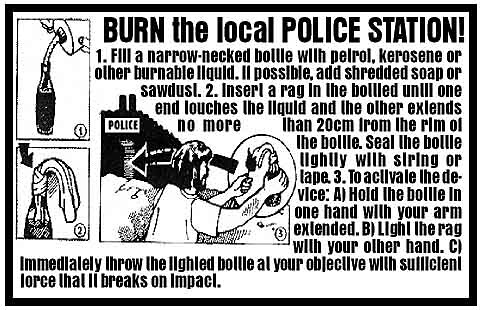
Of course, don't ever try this at home.
Of course, don't ever try this at home.
Friday, December 2
Grade Survey
Please fill out this grade self-survey before the end of the semester, thanks.
http://complicity.uvsc.edu/clipboard/survey.php?surveyid=10
http://complicity.uvsc.edu/clipboard/survey.php?surveyid=10
Tuesday, November 29
Do It Now by Steve Pavlina: "During one of these sacred time blocks, do nothing but the activity that's right in front of you. Don't check email or online forums or do web surfing. If you have this temptation, then unplug your Internet connection while you work. Turn off your phone, or simply refuse to answer it. Go to the bathroom before you start, and make sure you won't get hungry for a while. Don't get out of your chair at all. Don't talk to anyone during this time."
Do It Now by Steve Pavlina: "Trying to cut out time-wasting habits is a common starting point for people who desire to become more efficient, but I think this is a mistake. Optimizing your personal habits should only come later. Clarity of purpose must come first. If you don't have clarity, then your attempts to install more efficient habits and to break inefficient habits will only fizzle. You won't have a strong enough reason to put your time to good use, so it will be easy to quit when things get tough. You need a big, attractive goal to stay motivated. The reason to shave 15 minutes off a task is that you're overflowing with motivation to put that 15 minutes to better use."
Do It Now by Steve Pavlina: "Triage ruthlessly.
Get rid of everything that wastes your time. Use the trash can liberally. Apply the rule, 'When in doubt, throw it out.' Cancel useless magazine subscriptions. If you have a magazine that is more than two months old and you still haven't read it, throw it away; it's probably not worth reading. Realize that nothing is free if it costs you time. Before you sign up for any new free service or subscription, ask how much it will cost you in terms of time. Every activity has an opportunity cost. Ask, 'Is this activity worth what I am sacrificing for it?'"
Get rid of everything that wastes your time. Use the trash can liberally. Apply the rule, 'When in doubt, throw it out.' Cancel useless magazine subscriptions. If you have a magazine that is more than two months old and you still haven't read it, throw it away; it's probably not worth reading. Realize that nothing is free if it costs you time. Before you sign up for any new free service or subscription, ask how much it will cost you in terms of time. Every activity has an opportunity cost. Ask, 'Is this activity worth what I am sacrificing for it?'"
Do It Now by Steve Pavlina: "In college I was downright brutal when it came to triage. I once told one on my professors that I decided not to do one of his assigned computer science projects because I felt it wasn't a good use of my time. The project required about 10-20 hours of work, and it involved some tedious gruntwork that wasn't going to teach me anything I didn't already know. Also, this project was only worth 10% of my grade in that class, and since I was previously acing the class anyway, the only real negative consequence would be that I'd end up with an A- in the course instead of an A. I told the professor I felt that was a fair trade-off and that I would accept the A-. I didn't try to negotiate with him for special treatment. So my official grade in the class was an A-, but I personally gave myself an A for putting those 10-20 hours to much better use."
Do It Now by Steve Pavlina: "Use single handling.
Instead of using some elaborate organizing system, I stuck with very basic a pen-and-paper to do list. My only organizing tool was a notepad where I wrote down all my assignments and their deadlines. I didn't worry about doing any advance scheduling or prioritizing. I would simply scan the list to select the most pressing item which fit the time I had available. Then I'd complete it, and cross it off the list.
If I had a 10-hour term paper to write, I would do the whole thing at once instead of breaking it into smaller tasks. I'd usually do large projects on weekends. I'd go to the library in the morning, do the necessary research, and then go back to my dorm room and continue working until the final text was rolling off my printer. If I needed to take a break, I would take a break. It didn't matter how big the project was supposed to be or how many weeks the professor allowed for it. Once I began an assignment, I would stay with it until it was 100% complete and ready to be turned in.
This simple practice saved me a significant amount of time. First, it allowed me to concentrate deeply on each assignment and to work very efficiently while I worked. A lot of time is lost in task switching because you have to re-load the context for each new task. Single handling minimizes time lost in task switching. In fact, when possible I would batch up my assignments within a certain subject area and then do them all at once before switching subjects. So I'd do all my math homework in a row until it was all done. Then I'd do all my programming assignments. Then I'd do my general education homework. In this manner I would put my brain into math-mode, programming-mode, writing-mode, or art-mode and remain in that single mode for as long as possible. Secondly, I believe this habit helped me remain relaxed and unstressed because my mind wasn't cluttered with so many to-do items. It was always just one thing at a time. I could forget about anything that was outside the current context.
Failure is your friend.
Most people seem to have an innate fear of failure, but failure is really your best friend. People who succeed also fail a great deal because they make a lot of attempts. The great baseball player Babe Ruth held the homerun record and the strikeout record at the same time. Those who have the most successes also have the most failures. There is nothing wrong or shameful in failing. The only regret lies in never making the attempt. So don't be afraid to experiment in your attempts to increase productivity. Sometimes the quickest way to find out if something will work is to jump right in and do it. You can always make adjustments along the way. It's the ready-fire-aim approach, and surprisingly, it works a lot better that the more common ready-aim-fire approach. The reason is that after you've 'fired' once, you have some actual data with which to adjust your aim. Too many people get bogged down in planning and thinking and never get to the point of action. How many potentially great ideas have you passed up because you got stuck in the state of analysis paralysis (i.e. ready-aim-aim-aim-aim-aim...)?"
Instead of using some elaborate organizing system, I stuck with very basic a pen-and-paper to do list. My only organizing tool was a notepad where I wrote down all my assignments and their deadlines. I didn't worry about doing any advance scheduling or prioritizing. I would simply scan the list to select the most pressing item which fit the time I had available. Then I'd complete it, and cross it off the list.
If I had a 10-hour term paper to write, I would do the whole thing at once instead of breaking it into smaller tasks. I'd usually do large projects on weekends. I'd go to the library in the morning, do the necessary research, and then go back to my dorm room and continue working until the final text was rolling off my printer. If I needed to take a break, I would take a break. It didn't matter how big the project was supposed to be or how many weeks the professor allowed for it. Once I began an assignment, I would stay with it until it was 100% complete and ready to be turned in.
This simple practice saved me a significant amount of time. First, it allowed me to concentrate deeply on each assignment and to work very efficiently while I worked. A lot of time is lost in task switching because you have to re-load the context for each new task. Single handling minimizes time lost in task switching. In fact, when possible I would batch up my assignments within a certain subject area and then do them all at once before switching subjects. So I'd do all my math homework in a row until it was all done. Then I'd do all my programming assignments. Then I'd do my general education homework. In this manner I would put my brain into math-mode, programming-mode, writing-mode, or art-mode and remain in that single mode for as long as possible. Secondly, I believe this habit helped me remain relaxed and unstressed because my mind wasn't cluttered with so many to-do items. It was always just one thing at a time. I could forget about anything that was outside the current context.
Failure is your friend.
Most people seem to have an innate fear of failure, but failure is really your best friend. People who succeed also fail a great deal because they make a lot of attempts. The great baseball player Babe Ruth held the homerun record and the strikeout record at the same time. Those who have the most successes also have the most failures. There is nothing wrong or shameful in failing. The only regret lies in never making the attempt. So don't be afraid to experiment in your attempts to increase productivity. Sometimes the quickest way to find out if something will work is to jump right in and do it. You can always make adjustments along the way. It's the ready-fire-aim approach, and surprisingly, it works a lot better that the more common ready-aim-fire approach. The reason is that after you've 'fired' once, you have some actual data with which to adjust your aim. Too many people get bogged down in planning and thinking and never get to the point of action. How many potentially great ideas have you passed up because you got stuck in the state of analysis paralysis (i.e. ready-aim-aim-aim-aim-aim...)?"
Friday, November 25
The spoils (kottke.org): "On our first night in Saigon, we ran across a little shop that offered for sale, among other things, lots of 60s/70s-era Zippo lighters.
Me: How do you suppose they came to have those?
Meg: I don't want to know."
Me: How do you suppose they came to have those?
Meg: I don't want to know."
Monday, November 21
Friday, November 18
complete, rough draft due on Nov. 21
A rough draft of your entire project is due on Nov. 21, Monday at the beginning of class.
Also, please remember to annotate each section in some way, preferably with a header or footer, so I know who the author is.
frontmatter/endmatter requirements
Here are the frontmatter/endmatter requirements for your draft which is due on Monday, November 21st. See chapter 12, page 268 for descriptions of each:
Backmatter:
- Letter of transmittal: Not needed
- Cover: not needed until the final draft
- Title page: yes
- 200 word abstract: Yes, make it a descriptive abstract. It can be shorter than 200 words, actually.
- Table of Contents: Yes.
- List of Illustrations: save it for the final draft, you don't have time
Executive summary: Not needed.
Backmatter:
- Glossary (list of definitions): include if needed
- References/documentation: You'll need this in the final draft
- Appendices (page 281): yes, if needed.
See the revision checklist on page 282
Thursday, November 17
kottke.org :: home of fine hypertext products: "This is the big sticking point for most people, I think. If you choose to have a family or focus on your career or pursue a costly photography hobby, you might not have the money or flexibility to travel this way. But that's a choice you've made (on some level)...and I would argue that if you're 30 years old, you can arrange to make an overseas trip once every 3-5 years, and that's about 7-8 trips by the time you're 60."
Nothing like having some childless, single jackass with no commitments or job telling you how free you should be.
Nothing like having some childless, single jackass with no commitments or job telling you how free you should be.
Wednesday, November 16
Notes On The PhD Degree: "A Doctor of Philosophy degree, abbreviated Ph.D., is the highest academic degree anyone can earn. Because earning a Ph.D. requires extended study and intense intellectual effort, less than one percent of the population attains the degree. Society shows respect for a person who holds a Ph.D. by addressing them with the title ``Doctor''.
To earn a Ph.D., one must accomplish two things. First, one must master a specific subject completely. Second, one must extend the body of knowledge about that subject."
To earn a Ph.D., one must accomplish two things. First, one must master a specific subject completely. Second, one must extend the body of knowledge about that subject."
today in class
Today in class we'll be talking about using templates to standardize styles across documents. *Everyone* will have to create a template, email it to someone else in the room not on your team, and have them duplicate your style, print it out, and submit it.
Wednesday, November 2

Friday, October 28
: "4310: schedule for remainder of semester.
Week of:
October 31: Chapter 4 (writing collaboratively), Chapter 14 (graphics, revisited), lecture on document management.
November 2: 75% due, with layout. Chapter 11 (revisited) Chapter 6 (communicating persuasively), Chapter 7 (researching your subject)
November:
7: Chapter 8 (organizing your information), Chapter 9 (definitions and descriptions), Chapter 10 (revising for coherence),
14: Templates and style guides revisited. Chapter 11 (sentence style, revisited)
21: Full draft due.
28: Peer feedback workshops. Intensive editing workshop this week.
December:
5: Catchup week. Topics vary depending upon current state of projects.
7: Final draft due."
Week of:
October 31: Chapter 4 (writing collaboratively), Chapter 14 (graphics, revisited), lecture on document management.
November 2: 75% due, with layout. Chapter 11 (revisited) Chapter 6 (communicating persuasively), Chapter 7 (researching your subject)
November:
7: Chapter 8 (organizing your information), Chapter 9 (definitions and descriptions), Chapter 10 (revising for coherence),
14: Templates and style guides revisited. Chapter 11 (sentence style, revisited)
21: Full draft due.
28: Peer feedback workshops. Intensive editing workshop this week.
December:
5: Catchup week. Topics vary depending upon current state of projects.
7: Final draft due."
Thursday, October 27
Wednesday, October 26

Monday, October 24
Sunday, October 23
BGG Thread: Dungeoneer Sets, HeroScape & Expansions Up For Trade: "Dungeoneer Sets, HeroScape & Expansions Up For Trade"
Oregon Camping YURTS: "JESSIE M. HONEYMAN
Location: Adjacent to north boundary of Oregon dunes National Recreation Area.
On U.S. 101, 3 miles south of Florence.
Attractions/Services: Campground near freshwater Cleawox Lake sheltered by towering sand dunes, some reaching 500 feet high; hiker-biker, group camps; boat ramps on Cleawox Lake and at Woahink Lake; this park has 10 yurts.
Off-season events: Fall Festival, September; Holiday Festival of Lights, mid-November-December 31 and rhododendron Festival, mid-May; Florence.
For more information: 541.997.3641 or 800.551.6949."
Location: Adjacent to north boundary of Oregon dunes National Recreation Area.
On U.S. 101, 3 miles south of Florence.
Attractions/Services: Campground near freshwater Cleawox Lake sheltered by towering sand dunes, some reaching 500 feet high; hiker-biker, group camps; boat ramps on Cleawox Lake and at Woahink Lake; this park has 10 yurts.
Off-season events: Fall Festival, September; Holiday Festival of Lights, mid-November-December 31 and rhododendron Festival, mid-May; Florence.
For more information: 541.997.3641 or 800.551.6949."
What Matters Most Is What Lasts Longest: "Our family-centered perspective should make Latter-day Saints strive to be the best parents in the world. It should give us enormous respect for our children, who truly are our spiritual siblings, and it should cause us to devote whatever time is necessary to strengthen our families. Indeed, nothing is more critically connected to happiness—both our own and that of our children—than how well we love and support one another within the family.
"
"
What Matters Most Is What Lasts Longest: "Rampant materialism and selfishness delude many into thinking that families, and especially children, are a burden and a financial millstone that will hold them back rather than a sacred privilege that will teach them to become more like God."
Wednesday, October 19
Monday, October 17
Word Templates -- Introduction to Word Templates
Word Templates -- Introduction to Word Templates: "If you frequently create documents that contain a lot of specialized formatting but don't always contain the same text, you can save yourself a considerable amount of time if you create Word templates to use as the basis of future documents. By using Word’s template feature, you can focus your concentration on the content of the document and leave the formatting up to the template."
upcoming assignments:
For today, Monday: Just come to class.
For Wednesday and Friday: Chapter 13: Designing the document.
due on Friday: A style guide for your document. 2-4 pages, details in class.
For Wednesday and Friday: Chapter 13: Designing the document.
due on Friday: A style guide for your document. 2-4 pages, details in class.
Monday, October 10
00010
resources for chapter 11
We'll be working out of chapter 11 every day this week, so please read it closely
Sunday, October 9
SinceSlicedBread.com: "We're looking for fresh, new ideas for a better America. Do you have a common-sense idea that will improve the day-to-day lives of everyday Americans? Or an opinion on how working families can succeed in the new global economy?
You have until December 5, 2005, to submit your idea and to weigh in. A panel of judges will select the top 21 ideas. All of America will be able to vote on the finalists, and on February 1, one person will win $100,000—runners up receive $50,000 each."
You have until December 5, 2005, to submit your idea and to weigh in. A panel of judges will select the top 21 ideas. All of America will be able to vote on the finalists, and on February 1, one person will win $100,000—runners up receive $50,000 each."
Friday, October 7


Wednesday, October 5
Emerging Technology - Discover Magazine - science news articles online technology magazine articles Emerging Technology: "The difference between this Web 2.0 model and the previous one is directly equivalent to the difference between a rain forest and a desert. One of the primary reasons we value tropical rain forests is because they waste so little of the energy supplied by the sun while running massive nutrient cycles. Most of the solar energy that saturates desert environments gets lost, assimilated by the few plants that can survive in such a hostile climate. Those plants pass on enough energy to sustain a limited number of insects, which in turn supply food for the occasional reptile or bird, all of which ultimately feed the bacteria. But most of the energy is lost.
A rain forest, on the other hand, is such an efficient system for using energy because there are so many organisms exploiting every tiny niche of the nutrient cycle. We value the diversity of the ecosystem not just as a quaint case of biological multiculturalism but because the system itself does a brilliant job of capturing the energy that flows through it. Efficiency is one of the reasons that clearing rain forests is shortsighted: The nutrient cycles in rain forest ecosystems are so tight that the soil is usually very poor for farming. All the available energy has been captured on the way down to the earth.
Think of information as the energy of the Web’s ecosystem. Those Web 1.0 pages with their crude hyperlinks are like the sun’s rays falling on a desert. A few stragglers are lucky enough to stumble across them, and thus some of that information might get reused if one then decides to e-mail the URL to a friend or to quote from it on another page. But most of the information goes to waste. In the Web 2.0 model, we have thousands of services scrutinizing each new piece of information online, grabbing interesting bits, remixing them in new ways, and passing them along to other services. Each new addition to the mix can be exploited in countless new ways, both by human bloggers and by the software programs that track changes in the overall state of the Web. Information in this new model is analyzed, repackaged, digested, and passed on down to the next link in the chain. It flows.
"
A rain forest, on the other hand, is such an efficient system for using energy because there are so many organisms exploiting every tiny niche of the nutrient cycle. We value the diversity of the ecosystem not just as a quaint case of biological multiculturalism but because the system itself does a brilliant job of capturing the energy that flows through it. Efficiency is one of the reasons that clearing rain forests is shortsighted: The nutrient cycles in rain forest ecosystems are so tight that the soil is usually very poor for farming. All the available energy has been captured on the way down to the earth.
Think of information as the energy of the Web’s ecosystem. Those Web 1.0 pages with their crude hyperlinks are like the sun’s rays falling on a desert. A few stragglers are lucky enough to stumble across them, and thus some of that information might get reused if one then decides to e-mail the URL to a friend or to quote from it on another page. But most of the information goes to waste. In the Web 2.0 model, we have thousands of services scrutinizing each new piece of information online, grabbing interesting bits, remixing them in new ways, and passing them along to other services. Each new addition to the mix can be exploited in countless new ways, both by human bloggers and by the software programs that track changes in the overall state of the Web. Information in this new model is analyzed, repackaged, digested, and passed on down to the next link in the chain. It flows.
"
Emerging Technology - Discover Magazine - science news articles online technology magazine articles Emerging Technology: "Part of the beauty and power of the original Web lay in its simplicity: Web sites were made up of pages, each of which could contain text and images. Those pages were able to connect to other information on the Web through links. If you were maintaining a Web site about poodles and stumbled across a promising breeder’s home page, you could link to the information on that page by inserting a few simple lines of code. From that point on, your site was connected to that other page, and subsequent visitors to your site could follow that connection with a single mouse click. In some basic sense, those two pages of data were interacting with each other, but the exchange between them was rudimentary.
Now consider how a group of poodle experts might use the Web 2.0. One of them subscribes to a virtual clipping service offered by Google News; she instructs the service to scan thousands of news outlets for any articles that mention the word poodle and to send her an e-mail alert when one of them comes down the wire. One morning, she finds a link to a review of a new book about miniature poodles in her in-box. She follows the link to the original article, and using a standard blogging tool like TypePad or Blogger, she posts a quick summary of the review and links to the Amazon page for the book from her blog.
Within a few hours of her publishing the note about the new book, a service called Technorati scans her Web site and notices that she has added a link to a book listed on Amazon. You can think of Technorati as the Google of the blog world, constantly analyzing the latest blog posts for interesting new developments. One of the features it offers is a frequently updated list of the most talked-about books in the blog world. If Technorati stumbles across another handful of links to that same poodle book within a few hours, the poodle book itself might show up on the hot books list."
Now consider how a group of poodle experts might use the Web 2.0. One of them subscribes to a virtual clipping service offered by Google News; she instructs the service to scan thousands of news outlets for any articles that mention the word poodle and to send her an e-mail alert when one of them comes down the wire. One morning, she finds a link to a review of a new book about miniature poodles in her in-box. She follows the link to the original article, and using a standard blogging tool like TypePad or Blogger, she posts a quick summary of the review and links to the Amazon page for the book from her blog.
Within a few hours of her publishing the note about the new book, a service called Technorati scans her Web site and notices that she has added a link to a book listed on Amazon. You can think of Technorati as the Google of the blog world, constantly analyzing the latest blog posts for interesting new developments. One of the features it offers is a frequently updated list of the most talked-about books in the blog world. If Technorati stumbles across another handful of links to that same poodle book within a few hours, the poodle book itself might show up on the hot books list."
Monday, October 3
Chapter 20 due this week
Just a reminder that chapter 20 is going to be discussed this week, October 3-7 and it would behoove you to have it read!
Friday, September 30
: "Four Approaches
The four approaches can be summarized as follows: (1) The author is informed by his or her own history, background knowledge, discourse community, and current social context, and these factors influence the resulting text. (2) The reader is informed by his or her own history, background knowledge, and current social context – as well as by the discourse community of which he or she is a member – and this affects the way he or she reads and interprets a written work. (3) The author shapes his or her writing to fit the reading audience based on what he or she knows about the potential readers. (4) The reader’s notion of the author and his or her intentions shapes how the reader interprets the writing."
The four approaches can be summarized as follows: (1) The author is informed by his or her own history, background knowledge, discourse community, and current social context, and these factors influence the resulting text. (2) The reader is informed by his or her own history, background knowledge, and current social context – as well as by the discourse community of which he or she is a member – and this affects the way he or she reads and interprets a written work. (3) The author shapes his or her writing to fit the reading audience based on what he or she knows about the potential readers. (4) The reader’s notion of the author and his or her intentions shapes how the reader interprets the writing."
Re: Writing
Re: Writing: ">If technical writing (and/or on-line documentation) is becoming more
>colloquial in an attempt to be more easily understood, are editors letting
>mistakes slide? Are there types of documentation wherein editors/employers
>would be less likely to worry about mistakes like these?
Linguists know that no language has rules, merely conventions. What we call
'rules' are actually just mutually acceptable things that we've agreed to do
in common. 'Its' vs. 'it's' is only a common distinction, not natural law.
Thus, editors, especially in an era when 'high' (Latinate) English in
documentation is being gradually replaced by 'low,' or vernacular English,
are in a bind. On the one hand, any good editor wants to preserve the
language as a tool. Who wants chaos in letters? On the other hand,
vernacular is much livelier than Latinate English, more prone to shift and
change. A valid and defensible usage this year becomes next year's
stodginess. For example, I've been using contractions in this message, while
several years ago I'd be brought to book for it. (Notice how I've changed
construction in that last sentence. Is it permissible? Well...)
"
>colloquial in an attempt to be more easily understood, are editors letting
>mistakes slide? Are there types of documentation wherein editors/employers
>would be less likely to worry about mistakes like these?
Linguists know that no language has rules, merely conventions. What we call
'rules' are actually just mutually acceptable things that we've agreed to do
in common. 'Its' vs. 'it's' is only a common distinction, not natural law.
Thus, editors, especially in an era when 'high' (Latinate) English in
documentation is being gradually replaced by 'low,' or vernacular English,
are in a bind. On the one hand, any good editor wants to preserve the
language as a tool. Who wants chaos in letters? On the other hand,
vernacular is much livelier than Latinate English, more prone to shift and
change. A valid and defensible usage this year becomes next year's
stodginess. For example, I've been using contractions in this message, while
several years ago I'd be brought to book for it. (Notice how I've changed
construction in that last sentence. Is it permissible? Well...)
"
Career Guide
Career Guide: "At the other end of the spectrum a lot of software is being localised too. The most famous example is of Microsoft having a Hindi version of Office-2000. This will throw up lot of opportunities to vernacular technical writers. Agrees Guru, ' These people will be one of the hottest things in times to come'."
Career Guide
Career Guide: "What is the relevance of all this to a B-school student? Writing is a skill that goes a long way in helping one achieve success. Many successful people have acknowledged this fact. As part of their work, managers have to prepare a lot of reports, lay down policies and procedures, and prepare proposals and plans. Today technology is overriding and there is hardly a company that is untouched by it. So somewhere along the way their will always be an interface with technology. Hence Technical Writing becomes relevant for them. This has also become more relevant as the medium of information distribution has evolved. Says Guru,' Today the delivery medium is Net-based or through CD-ROMS. The manager has to take full advantage of the benefits offered by these mediums in terms of audio as well as visual aspects of the presentation. So what the manager is doing is performing the role of a technical communicator'. He further emphasises, ' Knowledge Management and Knowledge Distribution are some of the hottest emerging areas. It is a little far away in India. But it will soon descend on us. Management graduates with knowledge of Technical Writing will be hot property'."
Career Guide
Career Guide: "There are no formal channels of entry into this profession through a university degree or certification of any kind. To become a good technical writer one must possess good technical skill as well as communication skills. As Mr. Guru Kamath, a renowned technical writer and founder of Technical Writers of India (TWIN) puts it, ' One should be a good writer with an ability to grasp technology. The people on this profession are from different backgrounds. You have both people who have an arts background and a flair for technology as well as engineers who have a flair for writing'. Other important traits that a technical writer must possess apart from written skills are verbal and presentation skills."
Wednesday, September 28
Bedford, Freeman, Worth Publishers - Technical Communication
Bedford, Freeman, Worth Publishers - Technical Communication: "Technical Communication
Sixth Edition
Mike Markel (Boise State U.)"
Sixth Edition
Mike Markel (Boise State U.)"
Sunday, September 18
Wired News: Universe: Beige, not Turquoise: "Two Johns Hopkins University astronomers said in January they had averaged all the colors from the light of 200,000 galaxies and concluded that if the human eye could see this combined hue, it would be a sprightly pale green. That, they said, was the color of the universe.
But Karl Glazebrook and Ivan Baldry admitted Thursday that their conclusion was wrong. They had been tripped up by flawed software that was uncovered by color engineers who checked their data.
'It is embarrassing,' Glazebrook said. 'But this is science. We're not like politicians. If we make mistakes, we admit them. That's how science works.'
The effect of the error was that the computer picked a nonstandard white from its electronic palette and mixed it with the other colors to come up with the turquoise. When the error was corrected and replaced with a standard white index, beige was the result, Glazebrook said."
But Karl Glazebrook and Ivan Baldry admitted Thursday that their conclusion was wrong. They had been tripped up by flawed software that was uncovered by color engineers who checked their data.
'It is embarrassing,' Glazebrook said. 'But this is science. We're not like politicians. If we make mistakes, we admit them. That's how science works.'
The effect of the error was that the computer picked a nonstandard white from its electronic palette and mixed it with the other colors to come up with the turquoise. When the error was corrected and replaced with a standard white index, beige was the result, Glazebrook said."
No class on Monday
Hi,
Because you have a rough draft due in class on Wednesday the 21st, I want you to take Monday to meet as a group and take care of business, i.e. make sure everyone is on task and knows what they are writing. Your draft should be 2-4 pages per person.
In addition to meeting with your group, you need to start getting used to working as a team online, or collaborating. To that end, I would like you to do the following:
1. post your working draft to your group page in webct.
2. read and respond to each team member's draft before class on Wednesday. By respond, I mean:
a. look for any obvious problems or gaps
b. ask for definitions of key terms
c. point out where illustrations might be appropriate
d. point out any sentences that sound painful.
e. check if instructions are being provided in a logical sequence with no omissions
f. make the document as visually professional as you can. Start talking as a team about what your document should look like.
g. report on what your class accomplished and upload the resulting memo to your group files. Label it: distance collab. memo
Please contact me with any questions. You are welcome to use the class computers during the class hour. I will check your work Monday evening.
Because you have a rough draft due in class on Wednesday the 21st, I want you to take Monday to meet as a group and take care of business, i.e. make sure everyone is on task and knows what they are writing. Your draft should be 2-4 pages per person.
In addition to meeting with your group, you need to start getting used to working as a team online, or collaborating. To that end, I would like you to do the following:
1. post your working draft to your group page in webct.
2. read and respond to each team member's draft before class on Wednesday. By respond, I mean:
a. look for any obvious problems or gaps
b. ask for definitions of key terms
c. point out where illustrations might be appropriate
d. point out any sentences that sound painful.
e. check if instructions are being provided in a logical sequence with no omissions
f. make the document as visually professional as you can. Start talking as a team about what your document should look like.
g. report on what your class accomplished and upload the resulting memo to your group files. Label it: distance collab. memo
Please contact me with any questions. You are welcome to use the class computers during the class hour. I will check your work Monday evening.
Wednesday, September 14
Ethics Memo
Carson Groff
I used to work for a home security company in Chicago. It was one of those summer jobs that you can do and make a ton of money. As a technician, my job was to install the security systems that the salesmen sold. One of the problems that I faced was that the salesmen would lie all the time. They would either tell the people that it was going to be a law to have to own a security system so they should get one now, or they would say that the system could do all this fancy stuff that it really could not do. So when I went to the customer's house to install it, they would ask me questions about things the salesman told them and I was faced with the dilemma of telling the the truth and not getting paid for the install, or going along with the lie and getting paid.
I used to work for a home security company in Chicago. It was one of those summer jobs that you can do and make a ton of money. As a technician, my job was to install the security systems that the salesmen sold. One of the problems that I faced was that the salesmen would lie all the time. They would either tell the people that it was going to be a law to have to own a security system so they should get one now, or they would say that the system could do all this fancy stuff that it really could not do. So when I went to the customer's house to install it, they would ask me questions about things the salesman told them and I was faced with the dilemma of telling the the truth and not getting paid for the install, or going along with the lie and getting paid.
I talked to the salesmen all the time about not telling the customers false info, but they got more sales with the lies. The company knew about it too, but they wouldn't do anything either because they got more money too.
I think the company should have done something to stop it. It not only makes the company look bad, but people like me don't want to work for them. I ended up quitting before the summer was out.
Amazon.com: Books: Leadership on the Line: Staying Alive Through the Dangers of Leading
Amazon.com: Books: Leadership on the Line: Staying Alive Through the Dangers of Leading: "Leadership on the Line: Staying Alive Through the Dangers of Leading (Hardcover)"
Ethical Racing
Memo:
This article is interesting because it deals with something that we hear a lot about in sports. Each individual athlete has the right to train harder and eat better than the next. But in today?s world of athletics athletes are trying to take their ?game? to the next level. This is another case where and athlete has tired to give him self the advantage by making himself taller in order to win the sprint
In this case Postorius (the 17 year old runner) was using a prosthetic in a Paralympic game. The argument was that he was using prosthetic legs that made him unnaturally tall and gave him an unfair advantage. He has the rights to wear these however it violates the rules that would enable him to race fairly. This puts a negative view publicly on not only himself but the Paralympic games. It shows that Postorius like many major league baseball players who are under investigation do not care about their fellow athletes.
Go to: www. slate . msn .com
__________________________________________________
Do You Yahoo!?
Tired of spam? Yahoo! Mail has the best spam protection around
http://mail.yahoo.com
Monday, September 12
Memo
Alexis Bucceri
Engl 4310
MWF 12-1250pm
Memo
Are you a human experiment? Close to forty years ago approximately 399 black male members of a poor
These doctors took it upon themselves to conduct this study on these poor men, without informing them just what was happening. These
Not once were these human experiments told of the consequences their disease would have and not only consequences on themselves but also on their spouses and children. They never knew that they were not being treated for their illness; they just appreciated the free treatment from a doctor, a doctor who should have been trustworthy.
This study was completely unethical. It completely violates ethical rights. In a community people should have concern for their neighbor, their friends. A doctor takes an oath, he is supposed to save lives, not induce death. These doctors not only lied to their patients, they caused their death and possibly the death of the patient? spouses and children.
Regardless of this medical treatment being free to these men, they still had a right to honest treatment. Every man has the right to have their basic needs met in their community. These doctors were a part of this community and so they too should have cared for their patients, their neighbor. The most unethical part of this study was that the results would not alter any of the treatments for syphilis. After the loss of these lives, the loss of trust in a community and the loss of the trust in a country there was no advance for the treatment of syphilis. The study was therefore futile.
Unethical Conduct by Check City
By just paying $25 and canceling a lost check you would assume that you are protected. However a recent experience that a Draper business man had suggests the opposite. A check was dropped off at an employees' house and not delivered personally. The employee then claimed he never received the check. A new check was written and the old check was cancelled through the bank. When the worker cashed the original check at check city, the business man was required to pay the check.
Check City should have gone after the worker for the payment of the check that was cashed, not after the business man who had cancelled the check. They shouldn't have allowed the transaction to go through if the check wasn't valid and since they did it they should pay the price and try to get the money back from the employee who received double pay. It is not just for Check City to require the business man to pay for the check that was cancelled. He lost money paying for the cancellation of the lost check and then lost the full amount of the check in addition to that. Check city should right the problem by taking a loss for their mistake or regaining their loss from the unethical employee that cashed both checks.
David Miller
Ethic Problems
From: Marina Daghouz
To: Mark Crane
English 4310
Sept. 12, 2005
With each passing day every individual is faced with ethical problems
which one must employ his/her personal beliefs and values to answer
and overcome. All too often, in a society driven by the allure of
money, the decisions that are made are not necessarily the best
decisions. Case in point is a former employment situation I was not
particularly fond of; in so much I consider it to be my greatest
ethical dilemma.
Several years ago I was given an opportunity to work for a certain
individual who had been running her own business ventures for a brief
period of time. She needed some additional assistance to enable more
free time on her part as well as overall management of a handful of
these ventures. Unfortunately, I was to learn the hard way concerning
money and business ethics. The specific industry I was to be involved
in was that of network marketing or, less glamorously, pyramid
schemes. Included in these schemes were health food products,
internet-based learning "educational" opportunities and so forth. How
they were to be handled and managed was, both then and now, beyond my
personal code of ethics.
For the internet-based scheme, I was assigned to contact people
personally and convince them to purchase a package of investment and
business oriented material at the fine fee of roughly $2500.00. To
contact these individuals I had to purchase lists of names from
clandestine sources, not accredited or filtered by the Federal Do Not
Call List or any other regulatory firm, and continuously call them via
telephone and persuade them into believing this was a "once in a
lifetime event." Coupled with the calling approach, a man who was
deeply seeped in the industry taught me, at the behest of my boss, how
to "spam" people with multiple emails to thousands of individuals.
Spamming on such a grand scale had been deemed illegal, making it
necessary to go through a middle internet server.
Besides the spamming and illegal phone solicitations, the majority of
people I interviewed and presented my spiel to were generally
under-educated and financially challenged, seeking any get-rich-quick
schemes or impressionable enough to be contacted and convinced of this
necessity. I became Robin Hood in reverse, preying off the
ill-informed poor to the benefit of the wealthy. I was able to
accumulate 3-4 sales on this particular account on any given week.
The techniques and methods I used to accomplish my task were
extremely immoral and unethical. First and foremost, I lied in
multiple ways: pricing, false advertrsing, false product information,
unwilling to inform and filed questions, etc… The elements of
avaricious and greed continues to bring a disheartening feeling, even
presently. Deriving personal information on people and knowing how
this information would be used was also a great dilemma in dealing
with my position.
I had originally been hired and informed my job function would be
that of office manager, simply organizing the office, placing
legitimate phone calls, and keeping accounting records up-to-date.
Had I known the larger extent to which my skills would be used I would
have never dealt with such individuals. Like most ethical cases you
allow yourself to manipulated and gradually eased in with each new
situation. Seldom is it the case that you thrust yourself into a
situation and rob the entire bank, for instance. One must learn to
steal small things, meaningless things to aspire and justify the next
progressive step in the degradation of morals. In retrospect, I
should have recognized these patterns and terminated my employment
immediately; however, no such action was taken on my part, to great
remorse.
The purposeful intention my boss and other close associates of hers
had, in regards to their business practices, been well too much for my
moral and ethical disposition. To resolve matters, I made a sincere
personal pledge to never allow myself to be manipulated in any similar
way to this and to ensure all relations I engage into, whether
business or other, are honest and truthful. I was able to obtain
enough information and paper evidence to turn her, and a group closely
associated to her, into the IRS. There were many other dealings that
I was not directly or even indirectly involved with but, with how I
was used for deceitful purposes, I thought it imperative the business
dealings of these individuals should be brought to the appropriate
light.
If given the chance to repeat my actions I have deep, mixed feelings.
I definitely would would not perform the job and its actions ever
again, ensuring my ethics are upheld. The fact that I was able to put
an end to some very malicious business dealings seemed to have
justified my role, in the grand scope of things. However, I believe
overall that I would not repeat my actions, even if a descent amount
of good was the result. To compromise one's ethics is one of the
greatest ways of wronging one's self.
English 4310
DATE: September 12, 2005
TO: Professor Mark Crane
FROM: Todd Mickelson
SUBJECT: English 4310
I read an article about on November 17, 2003 that American Airlines
allowed a jet to fly that wasn't airworthy, apperantly the airplane had
leaky fuel tank.
Rights: Every passenger has the right to fly on an airplane that is
airworthy and also that the pilots and flight attendents work in an
airplane that is airworthy.
Justice: The passengers pay through their plane tickets to help pay
for the maintenance of the airplane, the company has the duty to keep
their planes in an airworthy status.
Utility: If the company doesn't keep their airplanes in an airworthy
condition then they will like to have a airplane crash, which would
potientaly hurt or even kill their passengers.
Care: Keeping an airplane in unairworthy condition disregards the care
for everyone. and will hurt the relationship that they have with
passengers.
Ethics
From: Dave Linton
To: Mark Crane
September 12, 2005
English 4310
My wife is a third grade teacher in Pleasant Grove.
Last school year was her second year
of teaching. The principal of this particular school
was growing more and more power
hungry. Each teacher was noticing that she was
apparently putting certain teachers on
her chopping block and trying to find anyway of
getting rid of them.
One fifth grade teacher, who somehow got on her bad
list, was fired, or rather,
his "contract was not renewed" because of an apparent
sexual remark he made towards
another teacher. This teacher however was not aware of
any remarks he made that
could have been construed as such. Moreover, the
complaint was not made by the
teacher who was the recipient of the remark, but
rather from a disgruntled student who
told her parents and they in turn told the principal.
With no questions asked he was fired
on the spot.
Naturally any person who actually makes such remarks
should be fired, but at least
some sort of investigation should be conducted to see
if the allegation is correct. The
teacher who was fired was not told who made the
complaint and also did not know who
the other teacher was of whom he supposedly insulted.
(the indentity of the student who
made the initial complaint came out later but the
teacher was not informed who that was
until he had already been fired). He strongly denies
that any situation took place or
remarks were said that could have been misunderstood
to such a severe degree.
He definately had the right to know who was accusing
him and also the right to defend
himself before he gets fired. The principle told him
that this situation would not appear on
his record and would not affect him being able to get
a job at another school. This
happened seven months and he still has not been able
to find a job. All the other
teachers were on his side and wanted to see him stay
at the school. They all knew he
was innocent of the charges but no one wanted to come
forward because of fear that
they would be next on the principal's chopping block.
__________________________________________________
Do You Yahoo!?
Tired of spam? Yahoo! Mail has the best spam protection around
http://mail.yahoo.com
4morals standards
Todd Petersen
Mike Stentzel
Sept. 12, 05
Send to- mecran01.4310@blogger.com
This is a good one to know. If you write a check and send it out to a
person or a company, and then cancel the check. There is still a chance
that you have to pay for the check you wrote out and you also paid the
25 dollar stop payment process.
memo
Memo: from Ken Senzig
To: mecran01.4310@blogger.com
Due to the unethical activity of Jet blue your personal information has
been given away. In September of 2002, JetBlue Airways secretly gave
the Transportation Security Administration and Torch Concepts (now
doing business as Torch Technologies) the Social Security number, date
of birth, and associated credit histories of many of the 5 million
passengers in the JetBlue database. Some of this information,
including SSNs, was posted by Torch Concepts to the Internet. The
document was freely available for download on the Internet for over six
months and was taken down on the 17th of September, 2003. This
sensitive travel data was then turned-over to a private security
contractor for analysis, the results of which were presented at a
security conference earlier this year and then posted on the Internet.
Let’s look at the rights of the individuals to be secure in private
information. This information could be damaging if it fell into the
wrong hands. This violated the welfare of the individual.
Utility is concerned with the effects on the public and this info can
have a harmful effect on individuals
Care is the relationship we have to other individuals and this creates
a negative relationship with Jet blue
I have traveled JetBlue from phoenix to John Wayne airport so I have
better watch my credit info.
ethical problem
from: Aric Hawkins
To: Mark Crane
English 4310
Sept. 12, 2005
The ethical problem i have encountered that i choose to discuss is one dealing with the UVSC parking enforcement. I recently recieved a parking pass on a car i just bought and it was not yet titled in my name. I asked a friend what i could do to get out of paying the ticket he told me to write a fake name and address for the car. Another friend told me to ignore the ticket and hope it ges away because the parking people couldnt run a licence plate number and track me down.
As I sat and thought about what i could do to get the ticket dismissed a large range of questions bombarded my mind. i thought about my right as a student being able to drive my car to school and having a few days inwhich i had time to find my classes and figure where the best place to park would be so i could minimize the time i wasted walking to my classes.
Another thought that came to mind was that it is not fair to students that have not had time to get a parking pass get ticketed within the first week of school. Most of the conversations i heard in the halls were that of the parking enforcement lack of care that it is the first week of school. I can understand if it was in January after half of the school year has gone by.
If the parking enforcement people are going to give out tickets on the first week of school they should at least post something around the whole school rather than just in the office area. some students do all of their registration stuff on line and forget to go to the one stop service desk in the administration building to get that taken care of.
After sorting through all my thoughts and advice I decided to go ask the parking people what i should do because i just purchased my car. They (for once) were friendly enough to tell me that i could go to the Utah State Tax Commission and get a form stating that i registered my car and had to change the title after the school year started.
Aric Hawkins
__________________________________________________
Do You Yahoo!?
Tired of spam? Yahoo! Mail has the best spam protection around
http://mail.yahoo.com
Moral Memo
One issue I deal with at work constantly relates to dealing with
customers. I work as a piano mover for a piano retail store. Many
times a piano may be damaged or have a defect or may even be a gray
market piano and the customer does not know. I am asked usually by the
saleperson or owner of the company to either ommit information or just
lie about the situation.
On the side of Rights, I think of my right to refuse to lie and
risk being reprimanded or disliked by my co-workers or supervisors.
On the justice side, the salesperson should be the one to disclose
the proper information regarding the piano to the customer. Also the
problem should be resolved in a just way. for example, if the piano is
damaged the company should pay to have it fixed or replaced.
at a Utility aspect, I look at the idea of the cost that the
company saves in leaving the customer with a defective piano as long as
the customer doesn't know. but the company also needs to realized the
moral standards they are imposing on their employees, and also the
effects their actions are going to have on a cusomer if they do find
out they have been lied to. also they may loose the customers trust.
as far as care is concerned, the salespeople especially, try to
say what the customer wants to here just to close the sale, when in
reality they only care about themselves and making money, even if this
means covering up their mistakes. I have a resposibility to myself and
my family to do what is right and being asked to lie to a customer
imposes on my rights.
I'm sure this is the same in many sales situations and is a
dilemma for many people.
Ethic Problems
From: Ryan Buelo
To: Class
9-12-05
There is a current problem at work that deals with nepotism. The unfair
favoring of a family member at the work place. A new policy needs to be set
in place so that raises and promotions are due to work done and not who you
are related to.
The rights of the employees demand that this stop and is fixed so that
family members are not promoted over more deserving employees. an
another aspect of this problem is the justice of this would be to fire those
members of family that don't complete the tasks necessary so that some more
deserving receives that job. justice demands that employees are promoted
fairly and through a rating system that rates everyone fairly.
it is necessary that the company hire family members because of the
difficulty in finding worthy employees. the family members know what they
are doing and deserve a job.
The problem is that family members care about one another and help each
other along. this isn't a bad thing care is important in the work place but
if it interferes with the promotion of worthy candidates it is unfair and
unjust.
Ryan Buelo
ethics in work
From: Chris Near
To: Mark Crane
English 4310
September 12, 2005
A situation that comes up commonly in the workforce is whether or not
to hire illegal immigrants. It is against state laws to do so, but
still many companies do it. This event is very common in construction
because companies can hire the immigrants to work for cheap with few if
any benefits.
State wide enforcement of this law is fairly relaxed at this time. Most
employers, if they want to, can get away with hiring illegal immigrants
with no visible consequences. The dillema then becomes one of rights,
justice, race, and ethics.
Many legal immigrants complain that employers should not higher illegal
immigrants because they are taking the jobs of the legal citizens who
feel that it is their right to have those jobs. Giving jobs to illegal
immigrants also causes racial tensions to rise even more. Look at the
wall of any urinal on a construction job sight and you are bound to see
how the white workers view their dark skinned, illegal immigrant
counterparts.
This issue also deals with the relationship between justice and
economics. Employers can argue that they are not at fault, but that in
fact it is the consumer that demands they higher cheaper labor in order
to keep costs low. If only legal citizens are hired then higher wages
are demanded along with insurance benefits. This caused the employer to
raise his prices which can lead to less work for him.
In the end it has become a tangled web with no clear answer in sight.
Chris Near
email: 10256178@uvlink.uvsc.edu
unethical practice
Jeff Baumann
baumannjeff@hotmail.com
Checker auto is the first company that comes to mind when it comes to
dealings with the company i work for. i work for a general contractor out of
salt lake. checker auto had our company and several others bid to remodel
several stores. they then gathered all the bids and instead of awarding the
bid to one of the companies they took the oweest sub contractor form each
bid and called them directly to have them come do the job. so they made the
generals get all the bids and do all the work and then bypassed them saying
they where the general contractors. i would say that this practice falls
under the area of justice. they have made it so that they save the expense
fo gathering subs and putting timetables together and shifted the cost on to
the generals who they had no intention of using to do the work only to put
information together at no cost.
Center for Studies of Ethics - Case Studies: "Case Prepared by Jerry, a Graphic Arts student
I was asked by my boss to prepare some government reports about how we dispose of waste products--specifically, how we discard paper and the used oil from our presses. I was told that we recycled our paper and that we had the oil picked up by a truck. I knew that wasn't true. The boss doesn't like to discuss anything, especially something like that. I did some asking around and found out that we used to do proper disposal, but it cost $714 to have the truck come and get the oil and grease, and that the person responsible before I got the job had decided it wasn't worth it because we had to pay the inspector $220 to come out and look at what we did, so he was taking the oil to the dump himself. I decided that I should ask the boss about it. It was an awful meeting. He told me that it was my responsibility to get rid of it, and I could either take it myself or take the money out of my salary. I knew that his decision wasn't a good decision, but I didn't want to lose my job. I decided to talk about it in one of our ethics discussions at College. The class was divided on whether I should blow the whistle on the boss; if I should haul the waste myself; or if I should fill out the papers as I had been told. After a lot of thought, I decided to haul it to a recycle place myself. It only took one Saturday morning every four months or so, but I think it isn't part of my responsibility. The company is still in business, which is the most good for the most people, and I am thinking right now that is the best decision. At least the oil is getting to the right place, and I do have my job. Before this class I probably would have just lied on the report. In a two page argument answer the following questions:
1. What are the ethical responsibilities of the company? What harms are being caused by the company?
2. What are the ethical responsibilities of Jerry's boss? What harms are being caused by Jerry's boss?
3. What are Jerry's ethical responsibilities?
4. Jerry selects a utilitarian argument with this case. Explain how this is an appropriate or inappropriate ethics justification."
I was asked by my boss to prepare some government reports about how we dispose of waste products--specifically, how we discard paper and the used oil from our presses. I was told that we recycled our paper and that we had the oil picked up by a truck. I knew that wasn't true. The boss doesn't like to discuss anything, especially something like that. I did some asking around and found out that we used to do proper disposal, but it cost $714 to have the truck come and get the oil and grease, and that the person responsible before I got the job had decided it wasn't worth it because we had to pay the inspector $220 to come out and look at what we did, so he was taking the oil to the dump himself. I decided that I should ask the boss about it. It was an awful meeting. He told me that it was my responsibility to get rid of it, and I could either take it myself or take the money out of my salary. I knew that his decision wasn't a good decision, but I didn't want to lose my job. I decided to talk about it in one of our ethics discussions at College. The class was divided on whether I should blow the whistle on the boss; if I should haul the waste myself; or if I should fill out the papers as I had been told. After a lot of thought, I decided to haul it to a recycle place myself. It only took one Saturday morning every four months or so, but I think it isn't part of my responsibility. The company is still in business, which is the most good for the most people, and I am thinking right now that is the best decision. At least the oil is getting to the right place, and I do have my job. Before this class I probably would have just lied on the report. In a two page argument answer the following questions:
1. What are the ethical responsibilities of the company? What harms are being caused by the company?
2. What are the ethical responsibilities of Jerry's boss? What harms are being caused by Jerry's boss?
3. What are Jerry's ethical responsibilities?
4. Jerry selects a utilitarian argument with this case. Explain how this is an appropriate or inappropriate ethics justification."
Thursday, September 8
Assistant Professor Position in Interactive Media Studies
The English Department at Clemson University invites applications for an
assistant professor position in Interactive Media Studies. Candidates with
research and teaching experience that involves the use of interactive media
in multiple contexts including e-learning and the use of serious games in
learning are especially encouraged to apply. Desirable candidates should
also exhibit interest and experience with interactive narratives and their
relation to computer game studies; the rhetorics of multi-user writing and
collaboration environments; digital literacy, theory and practice and their
relationships to the construction and experience of virtual worlds.
Candidates are expected to develop research and teaching agendas
commensurate with active scholars who situate their work in a broad network
of scholars with international presence. The candidate will be expected to
teach at the undergraduate level, in the MA Professional Communications
(MAPC) program, and in the new Ph.D. in Rhetorics, Communication, and
Information Design (RCID) program. The candidate is expected to collaborate
with both faculty and students in the programs. Teaching load: two courses
per semester.
Applications will be accepted from 15 September 2005 until 15 November
2005, or until the position is filled. Candidates must submit a letter of
application, CV, professional portfolio (papers, articles, e-projects on
DVD and Web, etc.), and at least three letters of recommendation to:
Victor Vitanza
Chair, RCID Search Committee
711 Strode Tower
Clemson, SC 29634
The English Department at Clemson University invites applications for an
assistant professor position in Interactive Media Studies. Candidates with
research and teaching experience that involves the use of interactive media
in multiple contexts including e-learning and the use of serious games in
learning are especially encouraged to apply. Desirable candidates should
also exhibit interest and experience with interactive narratives and their
relation to computer game studies; the rhetorics of multi-user writing and
collaboration environments; digital literacy, theory and practice and their
relationships to the construction and experience of virtual worlds.
Candidates are expected to develop research and teaching agendas
commensurate with active scholars who situate their work in a broad network
of scholars with international presence. The candidate will be expected to
teach at the undergraduate level, in the MA Professional Communications
(MAPC) program, and in the new Ph.D. in Rhetorics, Communication, and
Information Design (RCID) program. The candidate is expected to collaborate
with both faculty and students in the programs. Teaching load: two courses
per semester.
Applications will be accepted from 15 September 2005 until 15 November
2005, or until the position is filled. Candidates must submit a letter of
application, CV, professional portfolio (papers, articles, e-projects on
DVD and Web, etc.), and at least three letters of recommendation to:
Victor Vitanza
Chair, RCID Search Committee
711 Strode Tower
Clemson, SC 29634
Wednesday, September 7
Friday, September 2
Sufjan Stevens: Illinois: Pitchfork Review: "Stevens has a remarkable habit of being rousing and distressing at the same time, prodding disparate emotional centers until it's unclear whether it's best to grab your party shoes or a box of tissues. The gut-punching 'Chicago' cagily celebrates the innate (and deeply American) tendency to employ highways as escape routes, ditching old mistakes for new swatches of land, new plates of eggs, new parking lots. Impossibly propulsive, each calm, harmonized, Illinoisemaker cry of 'All things go!' pushes harder, promising liberation, by death or by automobile: 'If I was crying/ In the van with my friend/ It was for freedom/ From myself and from the land,' Stevens chokes, voice shaking over a haze of drums, strings, and shimmering keyboards."
Thursday, September 1
On July 29th, 2005, nine years after starting the graduate program at the University of Louisville, I finished my degree and defended my dissertation. I am $50k in debt, had four children during that time, and lived in four homes and two states. Three members of my committee left the program, and I learned more about academic politics than I ever wanted to know.
Using the New UV Link Email System
All UVSC students now have an email address in the new UV Link system. Because most of you have multiple email accounts (UVSC Groupwise, WebCT, UV Link, and at least one personal account), some clarification probably is in order. Please review the following information, and let me know if you have questions.
You can access this new email account through the UV Link portal by clicking on the Email icon in the upper-right corner of the UV Link main page.
Your address is your student (or Banner) ID number @uvlink.uvsc.edu (so mine, for example, would be 10004785@uvlink.uvsc.edu).
Because this address is highly impersonal, and because you have to log into the UV Link portal to check it, most of you probably will not opt to use it regularly.
It does, however, provide me with a quick and convenient way to email you, both individually and as a class, without having to gather and record students' addresses at the beginning of each semester. I do plan on making periodic use of this feature.
What I would ask you to do, then, is to turn on the Auto Forward feature in your UV Link email account, so that I can send messages to your UV Link address, and you can receive them in whichever email account you actually use.
To turn on Auto Forward:
Log into the UV Link portal
Click on the Email icon
Click on the Options tab
Click on the Auto Forward link
Type your preferred email address in the box
Click OK
I have turned on Auto Forward for my UV Link account. So if you forget the address that I actually use (youraddress@uvsc.edu), you can always contact me by clicking on the linked address next to our course in the My Courses area of the UV Link portal (the same place you go to enter WebCT).
All UVSC students now have an email address in the new UV Link system. Because most of you have multiple email accounts (UVSC Groupwise, WebCT, UV Link, and at least one personal account), some clarification probably is in order. Please review the following information, and let me know if you have questions.
You can access this new email account through the UV Link portal by clicking on the Email icon in the upper-right corner of the UV Link main page.
Your address is your student (or Banner) ID number @uvlink.uvsc.edu (so mine, for example, would be 10004785@uvlink.uvsc.edu).
Because this address is highly impersonal, and because you have to log into the UV Link portal to check it, most of you probably will not opt to use it regularly.
It does, however, provide me with a quick and convenient way to email you, both individually and as a class, without having to gather and record students' addresses at the beginning of each semester. I do plan on making periodic use of this feature.
What I would ask you to do, then, is to turn on the Auto Forward feature in your UV Link email account, so that I can send messages to your UV Link address, and you can receive them in whichever email account you actually use.
To turn on Auto Forward:
Log into the UV Link portal
Click on the Email icon
Click on the Options tab
Click on the Auto Forward link
Type your preferred email address in the box
Click OK
I have turned on Auto Forward for my UV Link account. So if you forget the address that I actually use (youraddress@uvsc.edu), you can always contact me by clicking on the linked address next to our course in the My Courses area of the UV Link portal (the same place you go to enter WebCT).
Tuesday, August 30
That said, my work is very influenced by Ken McAllister's approach to
computer games, which he outlines in his book, Game Work: Language, Power,
and Computer Game Culture. You might be familiar with this book, but if not,
it takes a very rigorous, Marxist approach to understanding what he calls the
computer game complex--the various, interdependent socio-economic forces that
produce computer games.
My approach is also indebted to Roger Callois's notions of paidic (sp?) and
ludic modes of play, especially in the way that these notions seem to connect
with Derrida's notion of freeplay and the way he interrogates linguistic
structures and systems (if you think about it, a computer game is one large
linguistic system). All of these threads come together nicely (too nicely?)
in Baudrillard's work on simulation and hyperreality, which I think is
especially pertinent to computer games.
I think that we do disagree about the direction game studies should take, but
like you said, I don't think that's necessarily a bad thing. As Ryan pointed
out in a previous thread, this sort of conversation has the potential to
generate new knowledge and approaches to the topic of computer games and of
all the things that are (always already!)implicated in computer games and in
the larger questions of reading and writing and learning.
Sincerely,
Kevin Moberly
computer games, which he outlines in his book, Game Work: Language, Power,
and Computer Game Culture. You might be familiar with this book, but if not,
it takes a very rigorous, Marxist approach to understanding what he calls the
computer game complex--the various, interdependent socio-economic forces that
produce computer games.
My approach is also indebted to Roger Callois's notions of paidic (sp?) and
ludic modes of play, especially in the way that these notions seem to connect
with Derrida's notion of freeplay and the way he interrogates linguistic
structures and systems (if you think about it, a computer game is one large
linguistic system). All of these threads come together nicely (too nicely?)
in Baudrillard's work on simulation and hyperreality, which I think is
especially pertinent to computer games.
I think that we do disagree about the direction game studies should take, but
like you said, I don't think that's necessarily a bad thing. As Ryan pointed
out in a previous thread, this sort of conversation has the potential to
generate new knowledge and approaches to the topic of computer games and of
all the things that are (always already!)implicated in computer games and in
the larger questions of reading and writing and learning.
Sincerely,
Kevin Moberly
Sunday, August 28
Saturday, August 13
Thursday, August 11
Tuesday, August 9
jwz: "Yes, it's that time of year again: the primary impact that Burning Man and methamphetamines have had on the computer industry is the SIGGRAPH Fashion Show. This year we learn that, In The Future, your clothing will look like an office building's HVAC system pooped on your head."
Sunday, August 7
Civicspace for Schools | CivicSpace: "IMHO, it would be a much better use of resources and more practical to develop a module for integrating Moodle with Drupal/CivicSpace. The perfect learning environment for me would be a nicely integrated combination (through special modules of connectors) of original implementations of: - Drupal/Civicspace, for virtual communities and content management features. - MediaWiki, for collaborative knowledge bases and reference content. - Moodle for e-learning environment and educational support. -----Original Message----- From: Nick Lewis"
CivicSpace Hosting Providers | CivicSpace: "Well,
Just to help out, I run a Drupal based site on BlueHost.
The Drupal installation was a snap with Fantastico, they give you plenty of databases and a ton of space for a pretty low montly fee (7 bucks a month I think)."
Just to help out, I run a Drupal based site on BlueHost.
The Drupal installation was a snap with Fantastico, they give you plenty of databases and a ton of space for a pretty low montly fee (7 bucks a month I think)."
Using Moodle: Glossaries Search: "Fantastico is an automatic installer for open source scripts such as Moodle. When you use it, Fantastico will install Moodle in less than five minutes, including setting up the Cron.
Fantastico is a service or feature provided by web hosting companies. You cannot get it yourself. If you cannot use a Moodle partner (the best solution!) for hosting your Moodle site, then look for a hosting service that has Fantastico--usually a feature included in the cPanel. A cPanel is the adminstration interface that you use to set up your site.
To find a hosting service with Fantastico, you can do a Google search, or look on a variety of sites that rate the hosting services. If you see a good hosting service, then check the feature list. If it does not include Fantastico, I recommend trying another hosting service.
Note that Fantastico takes up to six weeks to add new releases of Moodle. But upgrading is surprisingly easy."
Fantastico is a service or feature provided by web hosting companies. You cannot get it yourself. If you cannot use a Moodle partner (the best solution!) for hosting your Moodle site, then look for a hosting service that has Fantastico--usually a feature included in the cPanel. A cPanel is the adminstration interface that you use to set up your site.
To find a hosting service with Fantastico, you can do a Google search, or look on a variety of sites that rate the hosting services. If you see a good hosting service, then check the feature list. If it does not include Fantastico, I recommend trying another hosting service.
Note that Fantastico takes up to six weeks to add new releases of Moodle. But upgrading is surprisingly easy."
drupal vs. moodle set up | EdTechTalk.com: "I don't think there's any doubt that the way you want to go is with moodle. I think drupal has some very fine qualities, but it is not as easy to install as moodle. If you are using something like fantastico, or you are having someone else install your platform, moodle is particularly more useful, as the learning curve is pretty easy, kinda like a stroll up a set of steps to your favorite bar rather than the hike up the mountain to the beautiful view
dave
Wednesday, August 3
Memo Assignment
English 4310
I am writing this memo for the company I work for, which is a general contractor. The reason for this memo is that a sheetrock subcontractor is trying to collect their total bill on a $400,000 home that we are working on. The company is called Ross Sheetrock and they have so called completed their work. For this reason they are trying to collect the remaining balance of $8,000 for the total job. The reason for the memo is to let them know that we are very unpleased with the final sanding job they did and the delay they have put on the finish work, which we are doing.
Dear Jorge,
We regret to inform you of the poor job that we found as we tried to begin finish work last Wednesday. We found that very little sanding had been done as well as absolutely no clean-up had been performed. As a result we were forced to start cleaning up so that we could begin our finish work. That afternoon three individuals came to sand and clean-up but only were there for a total of three hours and did hardly anything. The following day one of them returned with his girlfriend present and began to spot sand a few spots to whom we expressed our dissatisfaction in the sanding that had been performed. He was not very happy with our expressing this and became irritated. He did have his girlfriend leave and continued to sand some areas but he didn’t stay very long. On Friday one of your supervisors came to talk with us and to see what had happened with the sanding and to find out why we got upset with the sanding crew. He was in total agreement of the poor job that was done and assured us that the sanding would be redone. He then showed the sanding crew, who showed backup later that morning, what they needed to do. The sanding crew stayed for a few hours and left. We would like a thorough inspection done on the sanding job at this time before any money is paid. We were very pleased with the hanging and texturing of the walls however, for a job of this size and price the teenage workers used for sanding were very unprofessional with the ending portion of the job. We look forward to an inspection so that we can get this problem resolved and behind us.
Sincerely,
Fait Construction
English 4310
I am writing this memo for the company I work for, which is a general contractor. The reason for this memo is that a sheetrock subcontractor is trying to collect their total bill on a $400,000 home that we are working on. The company is called Ross Sheetrock and they have so called completed their work. For this reason they are trying to collect the remaining balance of $8,000 for the total job. The reason for the memo is to let them know that we are very unpleased with the final sanding job they did and the delay they have put on the finish work, which we are doing.
Dear Jorge,
We regret to inform you of the poor job that we found as we tried to begin finish work last Wednesday. We found that very little sanding had been done as well as absolutely no clean-up had been performed. As a result we were forced to start cleaning up so that we could begin our finish work. That afternoon three individuals came to sand and clean-up but only were there for a total of three hours and did hardly anything. The following day one of them returned with his girlfriend present and began to spot sand a few spots to whom we expressed our dissatisfaction in the sanding that had been performed. He was not very happy with our expressing this and became irritated. He did have his girlfriend leave and continued to sand some areas but he didn’t stay very long. On Friday one of your supervisors came to talk with us and to see what had happened with the sanding and to find out why we got upset with the sanding crew. He was in total agreement of the poor job that was done and assured us that the sanding would be redone. He then showed the sanding crew, who showed backup later that morning, what they needed to do. The sanding crew stayed for a few hours and left. We would like a thorough inspection done on the sanding job at this time before any money is paid. We were very pleased with the hanging and texturing of the walls however, for a job of this size and price the teenage workers used for sanding were very unprofessional with the ending portion of the job. We look forward to an inspection so that we can get this problem resolved and behind us.
Sincerely,
Fait Construction
Monday, August 1
Sunday, July 31
Thursday, July 28
Sunday, July 24
Hi, sorry about the delay in posting Friday's assignment, I went out of town for the weekend. Here is what I need you to do:
1. Read the chapter I handed out in class on Wednesday on revising for readability.
2. Go through your existing drafts and find 10 sentences that need revising
3. Post them to the discussion area under "revising for readability"
4. Identify by name recurring problems that you see in your writing, based on the included sentences
5. revise the affected sentences.
Thanks!
1. Read the chapter I handed out in class on Wednesday on revising for readability.
2. Go through your existing drafts and find 10 sentences that need revising
3. Post them to the discussion area under "revising for readability"
4. Identify by name recurring problems that you see in your writing, based on the included sentences
5. revise the affected sentences.
Thanks!
Saturday, July 16
Ask E.T.: Rhetorical ploys in evidence presentations: "Rhetorical ploys in evidence presentations
Here is the beginning of a collection of rhetorical ploys in evidence presentations, verbal moves that replace real evidence.
FAUX CONSERVATISM This takes the form of 'Our results are conservative; we made conservative assumptions about the model.' The claim is that possible biases in assumptions work against the view advanced by the researcher. This is in fact an implicit error statement. Such claims are sometimes a rhetorical tactic that substitutes verbal fudge factors for quantitative assessments of error. See for example the Boeing/Columbia slide with the headline: Review of test data indicates conservatism for tile penetration
IGNORING SELF-CONTRADICTION See the Boeing slide. See also Richard Feynman's example in his Challenger report at page 137 of 'What do you care what other people think?':"
Here is the beginning of a collection of rhetorical ploys in evidence presentations, verbal moves that replace real evidence.
FAUX CONSERVATISM This takes the form of 'Our results are conservative; we made conservative assumptions about the model.' The claim is that possible biases in assumptions work against the view advanced by the researcher. This is in fact an implicit error statement. Such claims are sometimes a rhetorical tactic that substitutes verbal fudge factors for quantitative assessments of error. See for example the Boeing/Columbia slide with the headline: Review of test data indicates conservatism for tile penetration
IGNORING SELF-CONTRADICTION See the Boeing slide. See also Richard Feynman's example in his Challenger report at page 137 of 'What do you care what other people think?':"
Friday, July 15
For this Friday's online class I'd like you to do peer review. Your response should be at least 150 words, and detailed.
1. Post your current draft AS AN ATTACHMENT with the subject:
DRAFT: [your last name]
2. Respond to any draft that hasn't gotten a response yet, but only after you have posted your own draft. In the response message, (R)eply to the original with the subject:
RESPONSE: [your last name]
Hopefully this will be less confusing than the last time we tried this!
1. Post your current draft AS AN ATTACHMENT with the subject:
DRAFT: [your last name]
2. Respond to any draft that hasn't gotten a response yet, but only after you have posted your own draft. In the response message, (R)eply to the original with the subject:
RESPONSE: [your last name]
Hopefully this will be less confusing than the last time we tried this!
Monday, July 11
Attack of the Weasel Words - Newsweek Entertainment - MSNBC.com: "What are the “weasel words” you dislike most?
'Implemented.' You'll see implemented everywhere. In this language, you “implement” rather than speak or do. And then there is enhanced. Everything is being enhanced. That word is being used in place of other more precise and descriptive words. You can enhance your marriage or your job. You can even implement your enhancements. And 'input' is another good one. Companies talk about “input into our people.” This reflects technology and accounting [ideas]. It all has to do with input and outcomes."
'Implemented.' You'll see implemented everywhere. In this language, you “implement” rather than speak or do. And then there is enhanced. Everything is being enhanced. That word is being used in place of other more precise and descriptive words. You can enhance your marriage or your job. You can even implement your enhancements. And 'input' is another good one. Companies talk about “input into our people.” This reflects technology and accounting [ideas]. It all has to do with input and outcomes."
Friday, July 8
For today's online class (Friday, July 8th) I'd like you to do two thing:
1. Discuss the recent readings on usability, and usability in general, on the discussion board. Post at least a paragraph discussing the readings, and respond with at least a paragraph to someone else's posting. Some questions you might consider answering:
a. Can Neilsen's web criteria be effectively applied to paper documentation?
b. Does "usability" really matter, or is it just an annoying piece of jargon?
c. How on earth could this possibly apply to your jobs in the real world, if you don't become a technical writer?
You can probably come up with better questions on your own.
Ok, the second thing I need from you is to take that article on applying Neilsen's criteria to paper docs, and, using that checklist, design a simple usability form that your test subjects can use to evaluate the documentation you are bringing to class on Monday. Post your form to the discussion area for other class member's to get ideas from. It's ok if you plagiarize each other like crazy in this assignment, and you can post multiple drafts if you take an idea from someone and improve your original. try to keep it to one page, if possible.
1. Discuss the recent readings on usability, and usability in general, on the discussion board. Post at least a paragraph discussing the readings, and respond with at least a paragraph to someone else's posting. Some questions you might consider answering:
a. Can Neilsen's web criteria be effectively applied to paper documentation?
b. Does "usability" really matter, or is it just an annoying piece of jargon?
c. How on earth could this possibly apply to your jobs in the real world, if you don't become a technical writer?
You can probably come up with better questions on your own.
Ok, the second thing I need from you is to take that article on applying Neilsen's criteria to paper docs, and, using that checklist, design a simple usability form that your test subjects can use to evaluate the documentation you are bringing to class on Monday. Post your form to the discussion area for other class member's to get ideas from. It's ok if you plagiarize each other like crazy in this assignment, and you can post multiple drafts if you take an idea from someone and improve your original. try to keep it to one page, if possible.
Wednesday, July 6
Heuristic Inspections for Documentation: "We all are familiar with Jakob Nielsen's heuristics for evaluating the usability of interfaces. When I was conducting a study on documentation usability, I started wondering if there existed a similar set of heuristics for evaluating the usability of documentation. The natural place to pose such a question was the STC Usability SIG mailing list. The response was that there was no heuristics set available although someone had tried to open the discussion in the mailing list some time ago. An answer, which led to the list of heuristics presented below, was something along the line 'Well, now that you asked, why don't you put the heuristics together' and so I did.
Friday, July 1

Dear students,
I have lots of students right now, and I get tons of email. It would be really helpful if, when sending me a message, you put your course in the subject heading, like this:
Subject: [1010] Question about final paper
Of course, if you're in 2020 or 4310, you would put [2020] or [4310] respectively.
I'm filtering my email now, so if you *don't* follow that example I'll probably lose your note, or not get to it for several days.
Thanks!
I have lots of students right now, and I get tons of email. It would be really helpful if, when sending me a message, you put your course in the subject heading, like this:
Subject: [1010] Question about final paper
Of course, if you're in 2020 or 4310, you would put [2020] or [4310] respectively.
I'm filtering my email now, so if you *don't* follow that example I'll probably lose your note, or not get to it for several days.
Thanks!
About section page template: "The Usability Toolkit is a collection of forms, checklists and other useful documents for conducting usability tests and user interviews."
Heuristic Inspections for Documentation: "We all are familiar with Jakob Nielsen's heuristics for evaluating the usability of interfaces. When I was conducting a study on documentation usability, I started wondering if there existed a similar set of heuristics for evaluating the usability of documentation. The natural place to pose such a question was the STC Usability SIG mailing list. The response was that there was no heuristics set available although someone had tried to open the discussion in the mailing list some time ago. An answer, which led to the list of heuristics presented below, was something along the line 'Well, now that you asked, why don't you put the heuristics together' and so I did.
"
"
Improving User Documentation and Customer Care: "Improving User Documentation and Customer Care
by Cem Kaner, Ph.D., J.D. & David Pels, B.A.
In recent years, the Customer Care Survey of Service and Support Practices in the Software Industry has consistently reported that only about half of software publishers put their documentation through a formal test. We thought that these numbers were low, so we checked them at the Software Testing, Analysis & Review (STAR) conference (Orlando, May 16, 1996).
During a plenary session, Kaner asked attendees (software testers) whether their groups tested their companies’ user manuals. Confirming the Customer Care data, at least half the room stood up to signify that their companies did not. This means that reputable companies are not testing their manuals – companies who don’t care about quality don’t spend money to send testers to STAR."
by Cem Kaner, Ph.D., J.D. & David Pels, B.A.
In recent years, the Customer Care Survey of Service and Support Practices in the Software Industry has consistently reported that only about half of software publishers put their documentation through a formal test. We thought that these numbers were low, so we checked them at the Software Testing, Analysis & Review (STAR) conference (Orlando, May 16, 1996).
During a plenary session, Kaner asked attendees (software testers) whether their groups tested their companies’ user manuals. Confirming the Customer Care data, at least half the room stood up to signify that their companies did not. This means that reputable companies are not testing their manuals – companies who don’t care about quality don’t spend money to send testers to STAR."
Subscribe to:
Posts (Atom)


